Migrating to the cloud promises unparalleled flexibility, but it frequently introduces an unexpected challenge: fluctuating monthly infrastructure bills. For a cloud hosting pricing factors model, transitioning away from traditional fixed hardware costs means your expenditures are directly tied to real-time resource utilization. When workloads spike, your expenses follow suit. Understanding the underlying mechanisms behind these variable expenses is essential for modern business leadership.
Demystifying your invoice requires breaking down core infrastructure components alongside hidden operational necessities. By understanding the primary business cloud hosting elements, tech leaders and stakeholders can accurately forecast infrastructure costs, eliminate over-provisioning, and build highly cost-effective configurations that support sustainable operational expansion over time.
What are the primary cloud hosting pricing factors?
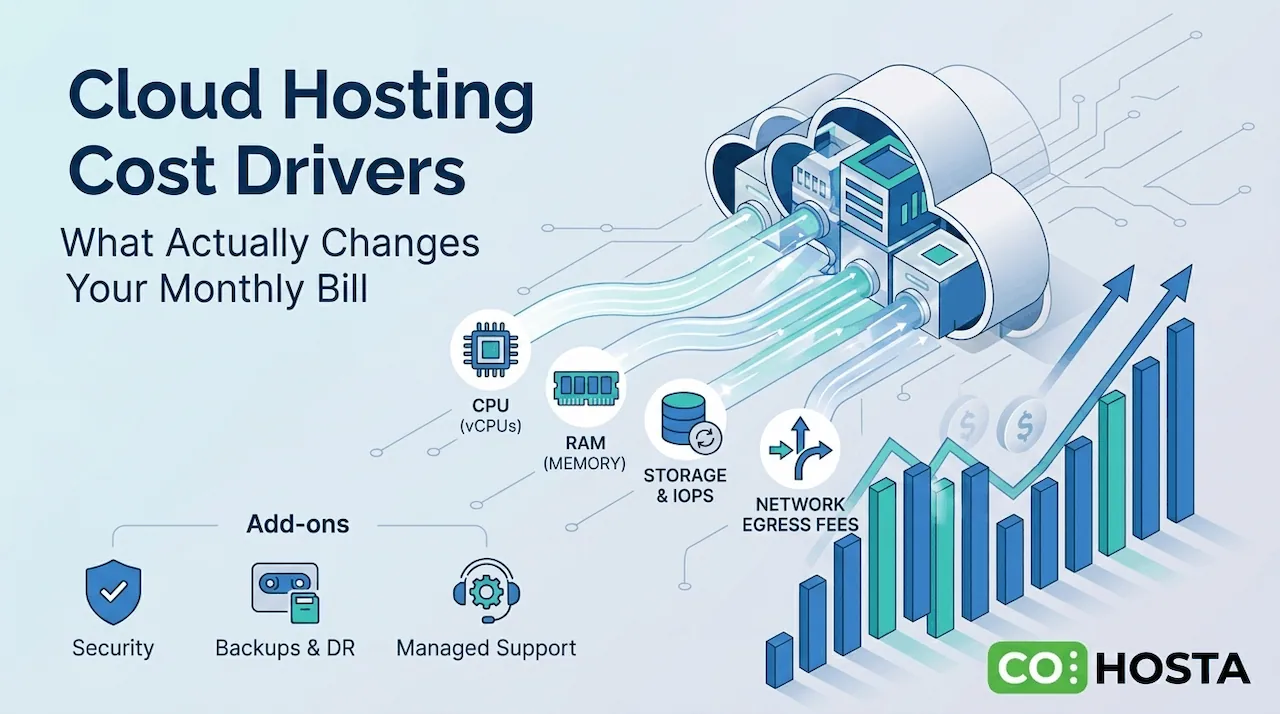
The primary cloud hosting pricing factors include core infrastructure resources such as CPU allocations, RAM capacity, data storage tiers, and network bandwidth. Beyond these hardware assets, monthly invoices are heavily influenced by operational add-ons including automated data backups, advanced security frameworks, software licensing fees, and professional managed technical support services.
The Core Pillars of Resource-Based Cloud Infrastructure Pricing
Modern cloud environments operate on a utility model. Much like electricity or water, you pay primarily for what you consume. However, because cloud infrastructure is multi-dimensional, your total expense is determined by a combination of four foundational hardware resources that scale with your application demand.
Central Processing Unit (CPU) and Computing Power
The CPU handles the logic, execution, and data computation required to keep your business applications running seamlessly. In a cloud architecture, processing power is typically provisioned via Virtual CPUs (vCPUs). Your billing is calculated based on both the number of vCPUs allocated to your environment and the total duration they remain operational.
Sustained high compute usage acts as a primary driver of your baseline hosting expenses. When building cloud hosting for growing businesses, allocating too many vCPUs during low-traffic periods results in financial waste, while provisioning too few causes application latency.
Random Access Memory (RAM) Allocation
RAM serves as the short-term working memory for active operating systems and applications. It dictates how many simultaneous processes your infrastructure can execute efficiently. Because RAM directly impacts application speed and overall user experience, scaling your memory capacity is critical during high-traffic windows.
Dynamic web applications and complex e-commerce engines require significant RAM allocations, making memory density a substantial component of any standard invoice. Unlike compute cycles which scale down rapidly, baseline memory allocation typically remains fixed to keep core server processes initialized and ready for unexpected requests.
Data Storage Architecture and Disk Performance Tiers
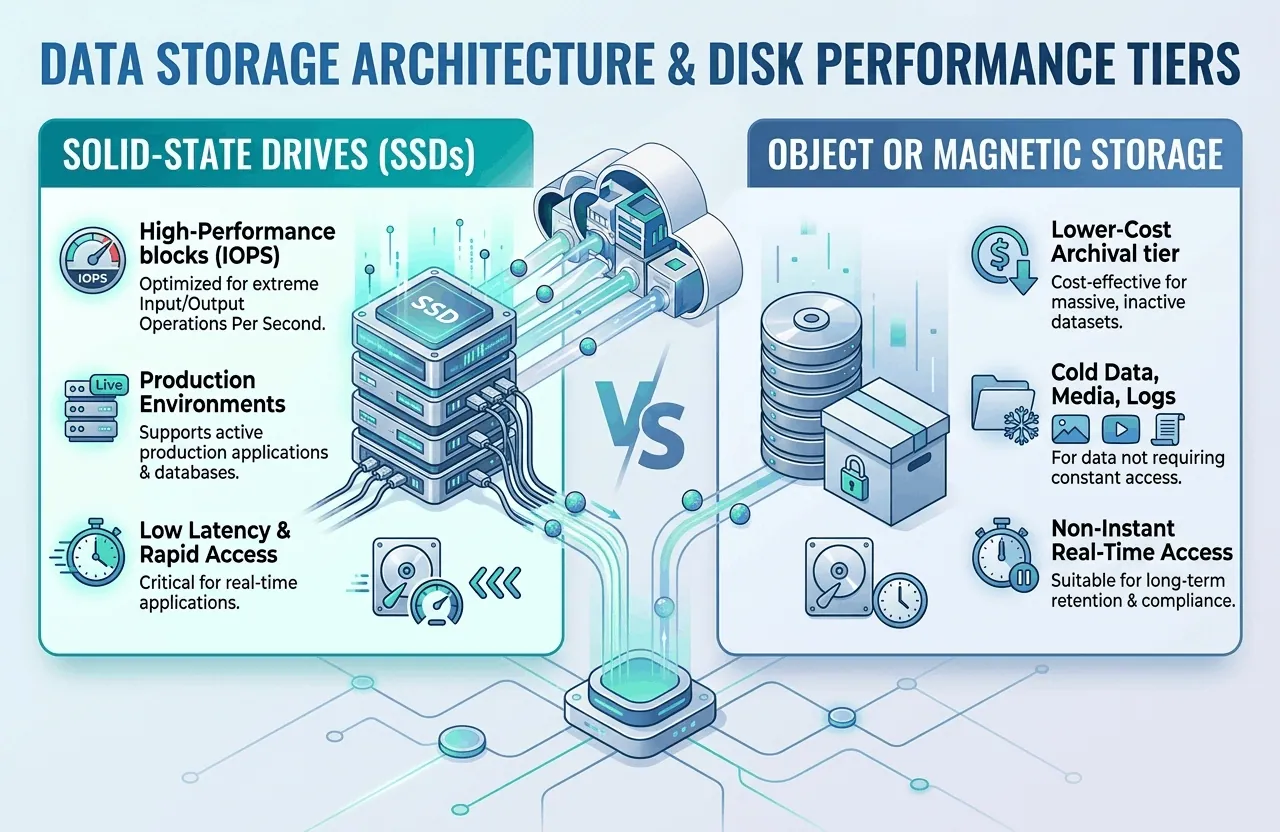
Cloud storage is no longer just about the volume of data you hold; it is heavily influenced by performance tiers and read or write speeds. Providers generally separate storage assets into two major categories to maximize efficiency:
- Solid-State Drives (SSDs): High-performance storage blocks required for production environments and active databases that demand low latency and rapid Input or Output Operations Per Second (IOPS).
- Object or Magnetic Storage: Lower-cost archival tiers designed for storing cold data, media libraries, or old compliance logs that do not require instant real-time access.
Selecting the wrong storage tier can quickly inflate expenses. Keeping active data on premium, high-IOPS SSD storage blocks is a necessary investment, but leaving historical, unaccessed data on those same premium disks leads to massive unnecessary spending.
Network Bandwidth and Data Egress Fees
While data entering a cloud ecosystem is almost universally free, moving data out of the cloud network represents an easily overlooked cost center. Bandwidth charges accumulate whenever your platform serves assets to end-users, streams media content, or transfers datasets to external networks. For digital operations, rapid audience expansion directly correlates with rising network transfer metrics, making efficient content delivery networks (CDNs) vital for controlling outbound traffic expenses.
Managing cloud spend has become the top priority for both enterprises and SMBs. 82% of all organisations are finding cloud spending their main challenge, ahead of security and lack of resources or expertise.
Operational Add-ons: Essential Services Beyond Basic Compute
Looking strictly at virtual hardware specifications tells only part of the story. Running a secure, reliable, enterprise-grade environment requires a layer of operational services that ensure business continuity and asset protection. Incorporating a robust scalable cloud hosting model necessitates reviewing these crucial add-on structures.
Automated Backup Strategies and Disaster Recovery
Protecting critical business records requires automated data replication. Backup costs are driven by your retention policies, snapshot frequencies, and geographic redundancy settings. Storing daily database snapshots across multiple separate data centers safeguards your operations against localized outages, but it also multiplies your storage footprint and corresponding infrastructure costs.
Comprehensive Cybersecurity and Compliance Mitigations
Maintaining a secure perimeter requires specialized tooling. Advanced Web Application Firewalls (WAFs), automated malware patching, managed Intrusion Detection Systems (IDS), and SSL certifications are defenses for any modern application. While these security measures protect your brand from catastrophic data breaches, they represent fixed operational add-on expenses.
Systems Engineering and Professional Technical Support
When an infrastructure anomaly occurs at midnight, having immediate access to senior systems architects is invaluable. Managed cloud providers offer tiered support structures ranging from self-service documentation to fully managed, 24/7 proactive monitoring with strict Service Level Agreements. Opting for a fully managed support framework increases your baseline cost but drastically reduces internal engineering overhead and business downtime.
How to Accurately Estimate Your Cloud Infrastructure Needs
Avoiding budget surprises requires transition planning from reactive spending to proactive resource forecasting. Businesses can systematically evaluate their technical prerequisites by following a structured engineering framework:
- Audit Existing Compute Metrics: Prior to migration, utilize performance monitoring tools to analyze your current CPU, RAM, and disk IOPS trends. Look for average baselines rather than designing exclusively around rare performance peaks.
- Isolate Dev and Test Environments: Non-production environments do not need to mirror the high-availability settings of production systems. Implement automated schedules to shut down testing instances outside of business hours to minimize unnecessary runtime charges.
- Enforce Lifecycle Storage Policies: Establish strict operational workflows that automatically transition aged assets, old logs, and historical backups to cold archival storage tiers after a designated period.
- Leverage Intelligent Autoscaling: Deploy architectures that dynamically scale resource footprints upward during traffic spikes and scale them safely downward when demand recedes, ensuring you only pay for compute capacity during active utilization.
Partner With Experts for Predictable, High-Performance Hosting
Navigating the granular technical details of infrastructure pricing can distract your internal development teams from building core product features. Choosing a hosting partner that pairs transparent, predictable resource scaling with elite optimization ensures your digital footprint expands efficiently without runaway costs.
Discover how tailored, robust infrastructure configurations can accelerate your platform performance and provide clear budget predictability by exploring our specialized solutions on the CoHosta Growth Cloud Hosting architectural framework. For long-term organizational success, managing your digital infrastructure requires a foundation of absolute transparency and elite support. Secure your digital assets and optimize your cloud strategies by partnering with CoHosta today.
Industry Benchmark Insight: According to the Flexera 2026 State of the Cloud Report, the rapid rise of enterprise AI workloads and complex modern services has reversed a five-year downward trend in infrastructure efficiency, pushing the average estimated cloud waste up to 29% of total infrastructure spending for modern organizations.
Source: TechInformed Analysis